
Why Better Signals Create Better Audience Strategies
Most advertisers don’t have an audience problem. They have a signal problem.
Modern advertising platforms generate more audience data than ever before, yet many marketers still struggle to identify which consumers are actually moving toward a purchase decision. As a result, media investments often prioritize scale over intent, creating larger addressable audiences without necessarily improving business outcomes. That’s what makes Amazon DSP particularly interesting.
While many advertising platforms focus on expanding audience reach, Amazon’s ecosystem provides something far more valuable: signals that provide stronger indicators of intent than traditional targeting methods alone. Shopping activity, browsing activity, streaming engagement, and purchase patterns create a richer picture of consumer decision-making than traditional targeting approaches alone. In a media environment where advertisers face growing pressure to improve efficiency, reduce wasted spend, and demonstrate measurable outcomes, success is becoming less about volume and more about signal quality.

Why Commerce Signals Matter
The advertising industry has never had a shortage of data. What advertisers continue to struggle with is determining which data points actually matter. As audience graphs grow larger and measurement systems become more sophisticated, the challenge is no longer collecting information. It’s identifying the signals most likely to indicate future behavior and meaningful business outcomes.
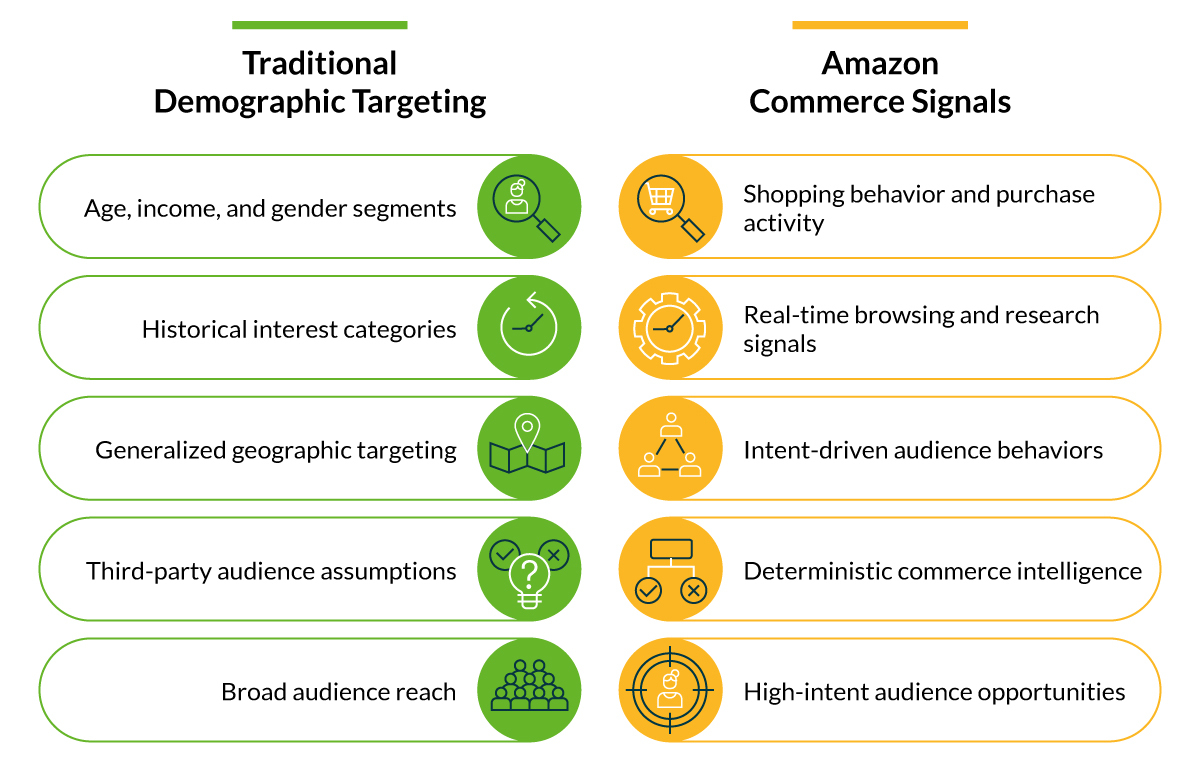
For years, audience targeting was built primarily around demographics, broad interests, and generalized assumptions about consumer preferences. While those inputs can provide useful context, they often fail to capture what consumers are actively preparing to do. Commerce-driven signals tell a different story. Instead of focusing solely on who consumers are, advertisers gain insight into what consumers are researching, browsing, streaming, purchasing, and considering in real time.
The distinction may seem subtle, but it fundamentally changes how audience strategy works.
From Consumer Activity to Audience Action
This shift from assumptions to observed behavior is helping advertisers make more informed decisions about where media investment can create the greatest impact. According to the IAB 2026 State of Data Report, marketers continue prioritizing better ways to connect consumer insights, measurement, and business outcomes as data environments become increasingly fragmented.
One of the biggest advantages Amazon DSP brings to modern advertising is its ability to transform commerce activity into actionable consumer insights. Every search, browse session, streaming interaction, and purchase activity contributes to a deeper understanding of consumer intent. Rather than relying exclusively on demographic assumptions or inferred interests, advertisers gain visibility into signals that often indicate where consumers are in their decision-making journey and what actions they may be preparing to take next.
This is where Amazon DSP becomes particularly powerful. The platform allows advertisers to activate audiences informed by shopping behaviors, browsing activity, content consumption, and purchase intent. The value is not simply access to more audience segments. The value comes from understanding which audiences demonstrate stronger indicators of future action.
From Addressable Audiences to Winnable Audiences
As targeting and measurement capabilities evolve, many advertisers are rethinking how they define opportunity. For years, success was measured by the size of an addressable market. Bigger audiences were often viewed as inherently better audiences. Today, a growing number of advertisers are recognizing that audience size and audience value are not the same thing.
At Choozle, we refer to this shift as the move toward Winnable Audiences.
Not every available audience represents a meaningful opportunity. The goal is to identify the consumers most likely to engage, convert, and contribute to measurable business outcomes. Instead of optimizing for potential reach, advertisers can focus on probable outcomes.
Our Winnable Market approach was built around this idea:
We also explored this evolution in greater detail in our infographic, The Shift to Winnable Audiences:
The concept aligns naturally with Amazon DSP because shopping, browsing, and streaming activity often provide stronger indicators of intent rather than traditional targeting methods alone. Rather than asking how many people a campaign can reach, advertisers can begin asking a far more valuable question: Which audiences are most likely to take action?

Five Audience Strategies Amazon DSP Unlocks
Amazon DSP provides several audience strategies that help advertisers move beyond broad reach and toward more precise audience activation.
- Lifestyle Audiences help advertisers reach consumers based on established interests, affinities, and behavioral patterns.
- In-Market Audiences focus on consumers actively researching products and categories, providing stronger signals of purchase intent.
- Lookalike Audiences help identify new prospects who share characteristics with existing high-value customers.
- Contextual Audiences align advertising with the content consumers are actively engaging with.
- Retargeting Audiences reconnect brands with consumers who have previously interacted with a product, brand, or digital experience.
On their own, each audience strategy offers value. Together, they enable advertisers to build more sophisticated activation strategies grounded in observed consumer actions rather than in generalized assumptions. Consider a simple example. A woman in Denver begins researching swimwear in January. Traditional demographic targeting might view that activity as an anomaly. Shopping, browsing, and streaming activity tell a different story. She may be planning an upcoming vacation, creating opportunities for travel brands, hospitality companies, apparel retailers, and related advertisers.
The audience itself hasn’t changed. What has changed is the quality of the signal. Commerce-driven insights allow advertisers to identify likely future actions that traditional audience models often overlook, creating opportunities to engage consumers based on observed behavior rather than broad assumptions.
Connecting Audience Intelligence to Outcomes
These insights become even more valuable when paired with omnichannel activation. Consumers rarely move directly from awareness to purchase. They move through a series of interactions across channels, devices, and touchpoints. Amazon DSP helps advertisers engage audiences throughout the customer journey across streaming TV (CTV), video, display, mobile, and other media environments while providing a more connected view of audience engagement.
This becomes particularly powerful when awareness and performance-focused media strategies work together. High-impact formats such as Streaming TV can help build awareness and consideration, while performance-oriented media helps drive measurable action. Together, these approaches create a more connected customer journey and a stronger understanding of how media investment contributes to business outcomes.
This is increasingly important as consumer behavior becomes more fragmented. Deloitte’s Digital Media Trends research found that consumers continue expanding the number of streaming services, content environments, and digital touchpoints they engage with, creating more complex customer journeys for advertisers to navigate. As media consumption becomes increasingly distributed across channels, understanding consumer intent is critical for identifying the most effective moments and environments for engagement.
The Future Belongs to Better Signals, Not Bigger Audiences
The future of audience strategy isn’t about reaching more consumers. It’s about identifying the signals that matter most. That’s where Amazon DSP delivers value.
It helps advertisers move beyond broad assumptions and activate campaigns based on real-world consumer activity. It creates opportunities to focus investment where intent is strongest, optimize campaigns around more meaningful audience signals, and build stronger connections between media activity and business outcomes.
Forrester’s 2026 Predictions suggest that marketers will face increasing pressure to demonstrate measurable business impact while navigating growing complexity across channels, technologies, and customer touchpoints. That reality is pushing advertisers to focus less on audience volume and more on identifying the signals most likely to drive outcomes.
In a media environment overflowing with data, competitive advantage no longer comes from audience volume. It comes from understanding which signals actually matter. The advertisers best positioned for growth will be the ones capable of identifying those signals, activating against them intelligently, and turning consumer insights into measurable business outcomes.
Ready to Move Beyond Broad Reach?
Amazon DSP gives advertisers access to commerce-driven audience intelligence that helps transform shopping, browsing, streaming, and purchase signals into more informed activation strategies. Combined with Choozle’s flexible campaign management experience, advertisers can identify more winnable audiences, improve targeting precision, and make more confident media investment decisions.

Tina Starr
Tina Starr is the Chief Executive Officer of Choozle, where she guides the company’s strategic direction, operational excellence, and long-term growth. With more than 15 years of experience in marketing, media, and technology, she is known for aligning teams around clear priorities, elevating performance standards, and delivering measurable outcomes for brands and agencies.
Before becoming CEO, Tina served as Executive Vice President of Revenue. She unified Sales, Account Management, and Media Solutions into a single integrated organization designed to improve performance, strengthen client relationships, and drive sustainable growth. She advanced Choozle’s market position by championing transparency, improving inventory quality, and expanding access to advanced measurement, enabling clients to connect investments to real business impact. She also built a deeper leadership bench and supported the advancement of women into senior roles.
Earlier, Tina served as Vice President of Account Management and Strategy, where she developed scalable programs, improved campaign execution, and led teams that consistently delivered stronger retention, revenue growth, and client outcomes. Before joining Choozle, she held senior roles at Next Step and HumanDesign and contributed to Google’s Premier Partner Program, shaping standards that influenced the broader performance marketing industry.
Tina is a collaborative and data-informed leader who combines strategic clarity with operational rigor. She mentors emerging leaders through Upnotch and DECA and has supported organizations such as the American Cancer Society, Habitat for Humanity, and Alpha Chi Omega. As CEO, she leads Choozle with a people-first mindset, ensuring that technology strengthens expertise and enables the company’s next era of innovation and customer-focused growth.